.jpeg)
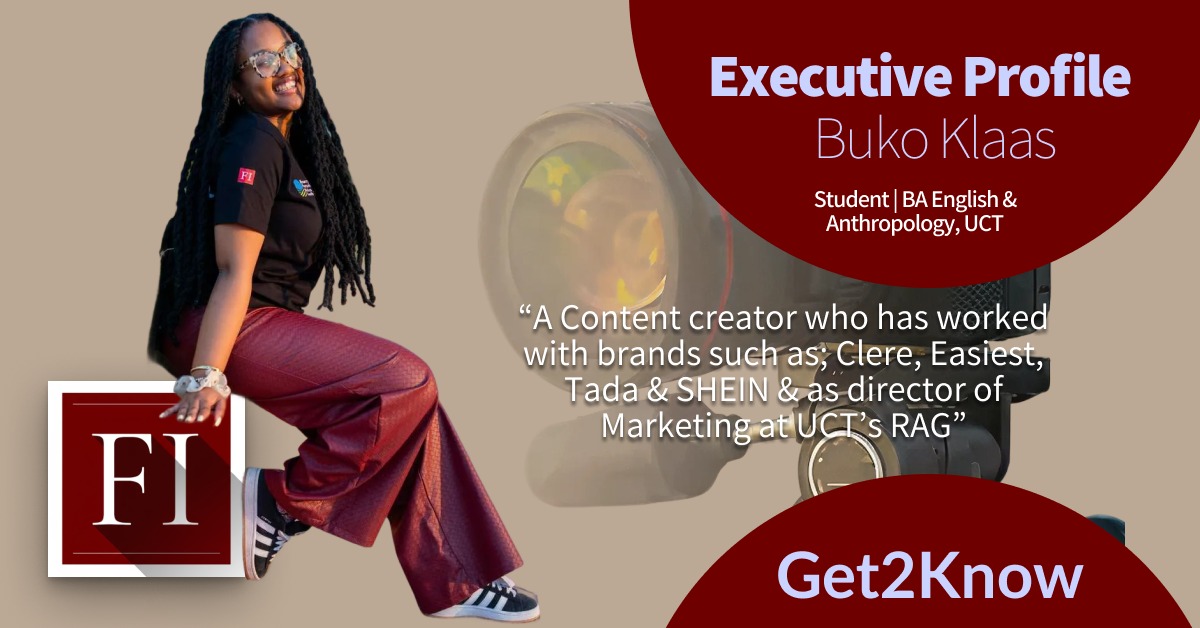
Clarence K. Chongo, AfricaWorks, Agora Village, LUSAKA | Monday, 17 November 2025 — Everyone warned her that English degrees lead nowhere except teaching jobs and coffee shops. Buko Klaas now produces content for ministerial interviews while her economics-major peers still search for their first real opportunity.
When Literature Meets Media Strategy
Knysna High School’s top English student in grade nine had no intention of becoming a media strategist. Buko Klaas simply loved stories—how they worked, why they mattered, what made people care. That fascination led her to the University of Cape Town, where she pursued English literature alongside anthropology, a combination that raised eyebrows among family members expecting a more “practical” career path.
Four years later, that supposedly impractical education became her sharpest professional weapon. While finance and marketing graduates memorised frameworks and business models, Klaas spent her undergraduate years learning what actually moves human beings: narrative structure, cultural context, symbolic meaning, and the mechanics of persuasion that predate modern advertising by millennia. She studied how Victorian novelists held reader attention across 800-page books. She examined how societies create and share meaning through ritual, symbol, and story.
Financial Insight Zambia hired her because her humanities background gave her exactly what they needed. Her role demands someone who can translate complex economic policy into content that real people will actually watch, read, and share. When the organisation secured access to Zambia’s Finance and National Planning Minister Dr. Situmbeko Musokotwane at the Mining Indaba, Klaas provided crucial media support, helping capture and shape content that would reach audiences across Southern Africa.
Building Reach Before Graduation
Most students treat campus organisations as resume padding. Klaas treated them as laboratories. At UCT Remember and Give (RAG), she took on the director of marketing role and immediately confronted a challenge that separates theoretical knowledge from actual skill: making people care about something when they have infinite other options for their attention and money.
RAG needed visibility, engagement, and ultimately participation. Klaas developed social media strategies that went beyond posting schedules and hashtag lists. She created content that stopped the scroll—materials that made students pause, feel something, and act. Managing Instagram channels meant monitoring what worked and what died, responding to comments and questions, and building relationships with followers who could easily ignore everything she produced.
Her results earned her the next opportunity. TeachOut UCT appointed her Head of Digital Media and Design, a full-time position overseeing all social media profiles and leading creative direction for the organisation. For over a year, from August 2023 through November 2024, she supervised content creation, design output, and digital strategy across multiple platforms.
Brands noticed. Clere, Easiest, Tada Promotions, and SHEIN brought her on for content creation and social media promotion. Each collaboration added another layer to her understanding of how different audiences respond to different approaches, how brand voice shifts across sectors, and how to create advertisements that people might actually want to see.
The Anthropology Advantage
Her anthropology training provides an edge that puzzles competitors with more conventional credentials. Where others see demographics and target markets, Klaas sees cultures, communities, and meaning systems. Anthropology teaches pattern recognition at the deepest level—how groups form identity, how status gets signalled, how information flows through social networks, and how people decide what matters.
That lens changes everything about content strategy. Klaas reads comment sections like ethnographic field notes, identifying the unspoken rules of online communities, the tribal boundaries between groups, and the symbolic capital that different content types carry. She recognises social media platforms as cultural spaces with their own norms, hierarchies, and rituals—complete environments requiring the same careful observation anthropologists bring to any human community.
Financial media presents a particular challenge: making topics that sound boring become compelling to people who think economics exists somewhere far removed from their daily lives. Policy decisions about national budgets and mining regulations affect every single person—their job prospects, food prices, transport costs, and future opportunities. Yet most coverage remains trapped in jargon that excludes the very audiences who need the information most. Klaas approaches each piece of content as a translation problem, taking ministerial interviews and creating something that university students, small business owners, and young professionals will all find worth their time.
Her English literature background solves the other half of that equation. Great writers know how to open a piece so readers cannot look away. They understand pacing, tension, and the exact moment when explanation turns into tedium. Klaas brings those instincts to every caption, every video edit, and every content calendar she builds.
What Makes Her Different
Plenty of young media professionals can edit footage or schedule posts. What separates Klaas is velocity. She moved from campus organisations to brand collaborations to financial media work before finishing her degree. Each role built directly on the previous one, carrying more responsibility, visibility, and complexity than the last.
Her academic record demonstrates consistent high performance: a 75% average at Knysna High School, top ten in her grade, and first place in English. More telling than the numbers is what they represent—a pattern of doing exceptional work when surrounded by people doing merely good work.
Her skills span both creative and analytical domains. She writes and speaks well, thinks structurally about long-term goals, manages deadlines and teams, and handles data analysis. That combination is rarer than it appears. She also works fast. When you manage social media for multiple organisations, create content for brand partnerships, and support media production for ministerial interviews—all while completing a university degree—you learn to execute quickly without sacrificing quality.
Where Talent Goes Next
Klaas identifies herself as open to campus influencer, campus ambassador, and marketing roles. Given her trajectory, those positions seem like lateral moves. Someone who already manages brand relationships, oversees content strategy, and produces media for finance ministers has outgrown entry-level ambassador work.
Her actual value sits at the intersection of three capabilities that rarely overlap: cultural analysis through her anthropology training, storytelling through her English background, and demonstrated execution through her work with RAG, TeachOut, Financial Insight Zambia, and brand partnerships. Organisations looking for that specific combination face a thin candidate pool.
Financial media outlets across Africa need people who can make economic news accessible without dumbing it down, who understand both the policy substance and the communication challenge. Brands targeting young African consumers need strategists who actually understand those audiences as cultures rather than demographics. Media companies building digital presence need leaders who have managed real accounts with real consequences—people who know what happens when strategy meets actual human audiences with the power to ignore, mock, or amplify your work.
Her South African base at the University of Cape Town positions her within one of the continent’s most connected creative and media markets. Cape Town serves as a production hub for international campaigns, a testing ground for pan-African digital strategies, and a talent pipeline for organisations across multiple sectors. Her education there, combined with her work experience spanning both South African organisations and Zambian media, gives her cross-border fluency that becomes increasingly valuable as African media and marketing mature beyond purely local focuses.
Opportunities will come—her track record makes that inevitable. What matters is whether she chooses roles that use her full range of capabilities. Marketing roles exist everywhere. Positions requiring someone who can decode culture, craft narrative, manage teams, execute strategy, and produce compelling content across platforms—those remain scarce. She can do all of that before turning 25, with proof points most early-career professionals cannot match.
Career advisors love tidy paths: finance degrees for finance careers, marketing degrees for marketing work, journalism degrees for media jobs. Buko Klaas demonstrates why that advice fails anyone with actual talent. Her English literature and anthropology training taught her to understand what moves people, how stories work, and why cultural context determines everything. Business frameworks change every decade. Human nature does not. She bet on the constant rather than the trend, and the market is proving her right.