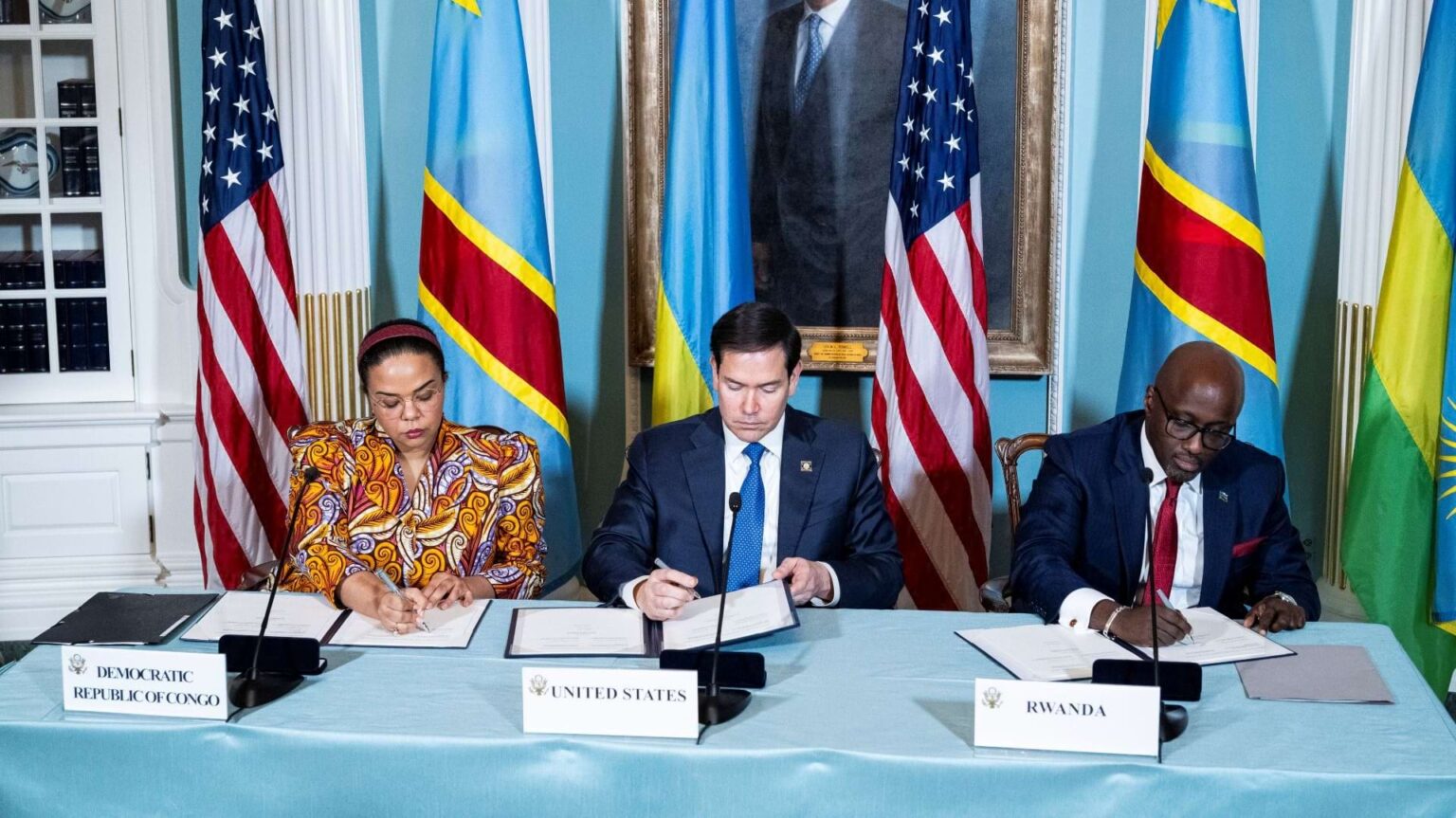
The US-DRC deal and Lobito Corridor represent a historic moment. Whether it becomes a turning point depends on choices African governments make now
The ink on the US-DRC Strategic Partnership Agreement signed last week in Washington is barely dry, but its implications will reverberate across the continent for decades. For the first time since independence, an African nation has secured a comprehensive strategic partnership with the United States built explicitly around its mineral wealth. The question African leaders must now confront is whether this agreement, and the broader scramble for critical minerals it represents, will finally deliver the industrial transformation that previous commodity booms promised but never achieved.
The stakes could not be higher. The Democratic Republic of Congo produces roughly 70 percent of the world's cobalt. Zambia sits atop one of the planet's richest copper deposits. Together with Angola's Atlantic ports and hydroelectric potential, Southern and Central Africa holds the keys to the electric vehicle revolution, the renewable energy transition, and the defence industries of every major power.
The Americans, Europeans, and Chinese all understand this. The December agreement makes Washington's intentions explicit: a Strategic Asset Reserve that grants US companies first right of offer on DRC's most valuable mineral concessions, ownership restrictions that will squeeze out Chinese investors over two decades, and commitments to route half of DRC's copper exports through the US-backed Lobito Corridor rather than southward through ports where Chinese logistics firms have built commanding positions.
In exchange, Kinshasa receives recognition as a "strategic partner," security cooperation following June's peace deal with Rwanda, promises of infrastructure financing including the long-delayed Grand Inga hydropower project, and fiscal incentives including a ten-year tax stabilisation clause. The Americans are also committing to help formalise artisanal mining through the Entreprise Générale de Cobalt, addressing one of DRC's most intractable governance challenges.
These are not trivial benefits. But African policymakers should read the fine print carefully.
The agreement's ownership provisions tell a revealing story. Today, non-aligned investors (read: Chinese companies) can hold up to 40 percent of qualifying projects. In ten years, that drops to 20 percent. In twenty years, just 10 percent. The US is not simply seeking access to Congolese minerals; it is seeking to restructure the ownership of DRC's entire mining sector over a generation. The five-year notice period for termination means that once locked in, reversing course becomes extraordinarily costly.
Meanwhile, the Lobito Corridor MOU that underpins much of the infrastructure promise is explicitly non-binding. It creates no legal obligations for any party. The difference between the binding commitments DRC has made and the aspirational language of what it receives in return deserves scrutiny.
None of this means the agreement is necessarily a bad deal. American partnership may prove more valuable than Chinese investment, particularly if Washington delivers on Grand Inga and the security cooperation that Kinshasa desperately needs in its eastern provinces. But African negotiators must be clear-eyed about the asymmetries.
The deeper issue is what this moment reveals about Africa's position in the emerging critical minerals order. Three competing visions are now on offer.
The European Union's Critical Raw Materials Act emphasises sustainability standards, certification schemes, and partnerships that contribute to local value addition. It is regulatory governance dressed in development language, and it assumes African producers will accept European norms in exchange for market access.
China's approach remains what it has always been: state-directed investment seeking control over supply chains, agnostic about governance standards, offering infrastructure and finance without political conditions. For governments chafing at Western lecturing, the appeal is obvious.
The American model, now visible in granular detail through the DRC agreement, is alliance-based resource security. Minerals flow to trusted partners; ownership concentrates among aligned nations; supply chains are restructured to exclude strategic competitors. It offers security guarantees and development finance but demands geopolitical alignment in return.
Each model has elements African nations can use. The challenge is combining them strategically rather than accepting any single framework wholesale.
What would strategic sophistication look like in practice?
First, maintain optionality. Zambia has notably not signed a bilateral partnership with Washington despite participating in the Lobito Corridor. This preserves flexibility. Countries should seek arrangements that allow engagement with multiple partners rather than exclusive commitments that foreclose future options.
Second, prioritise energy. Without reliable power, processing at scale is impossible regardless of other incentives. Grand Inga has been "imminent" for decades. Countries should pursue distributed renewable solutions that can come online faster while the mega-projects inch forward.
Third, build regional coordination. Individual African nations lack the market power to set terms with great powers. Collective action through the African Union, SADC, and purpose-built institutions can substantially enhance bargaining positions. The Lobito Corridor itself demonstrates what regional integration could achieve; the question is whether African governments or external partners will set its terms.
Fourth, embrace sustainability standards as competitive advantage rather than external imposition. Countries with robust environmental governance and transparent revenue management will access premium European markets and attract ESG-oriented capital. These are not colonial impositions; they are alignment with genuine national interests.
Fifth, invest in human capital now. The processing facilities that infrastructure enables will require skilled workers. Whether Africans capture those jobs or watch them go to imported technicians depends on investments in technical education made today.
The critical minerals moment is different from previous commodity booms. The green transition represents structural demand growth that will persist for decades. Electric vehicles, renewable energy systems, and grid storage all require copper, cobalt, lithium, and rare earths in quantities that current supply chains cannot deliver. African producers have leverage that their predecessors never enjoyed.
But leverage means nothing without the capacity to use it. The real question is not whether the US-DRC agreement is good or bad in the abstract. It is whether African institutions are strong enough, African negotiators skilled enough, and African political will focused enough to extract genuine development benefits from the competition now unfolding.
Previous generations watched their oil, their diamonds, their gold flow outward while the promised transformation never materialised. The minerals beneath African soil will power the twenty-first century economy. Whether Africans benefit this time depends on choices being made right now, in Kinshasa and Lusaka and Luanda, in Pretoria and Addis Ababa.
The scramble continues…. The question is whether Africa will finally write its own rules.

Savior Mwambwa is a Development Economist, Practitioner and researcher specializing in African economic transformation and development, extractive industries governance, and international development finance. His work focuses on how African nations and Global Majority nations can leverage their natural resource endowments for sustainable industrialization and broad-based economic transformation.