Mozel Chimuka, AfricaWorks, AgoraVillage | 15 May 2026 — A nation can wire its cities, string poles along its highways, and declare an access milestone and still leave its poorest citizens no better off. Zambia's national electricity access rate reached 51% in 2023, a figure that masks a rural reality of under 20% coverage and a subsidy structure so inverted that it transfers the bulk of its benefits upward, not downward, through the income ladder. The World Bank’s Zambia Economic Update 2026 puts these numbers on the table, and what they reveal is a stark disconnect between macroeconomic gains and the daily realities of the people.
Progress on Paper
Progress, in energy policy, is often measured in connections. How many households are on the grid. How many kilometres of transmission line have been laid. How many rural communities have, for the first time, switched on a light. These are real achievements, incomplete ones, all the same, and in Zambia, the gap between what the numbers announce and what the poorest households experience is wide enough to demand serious rethinking.
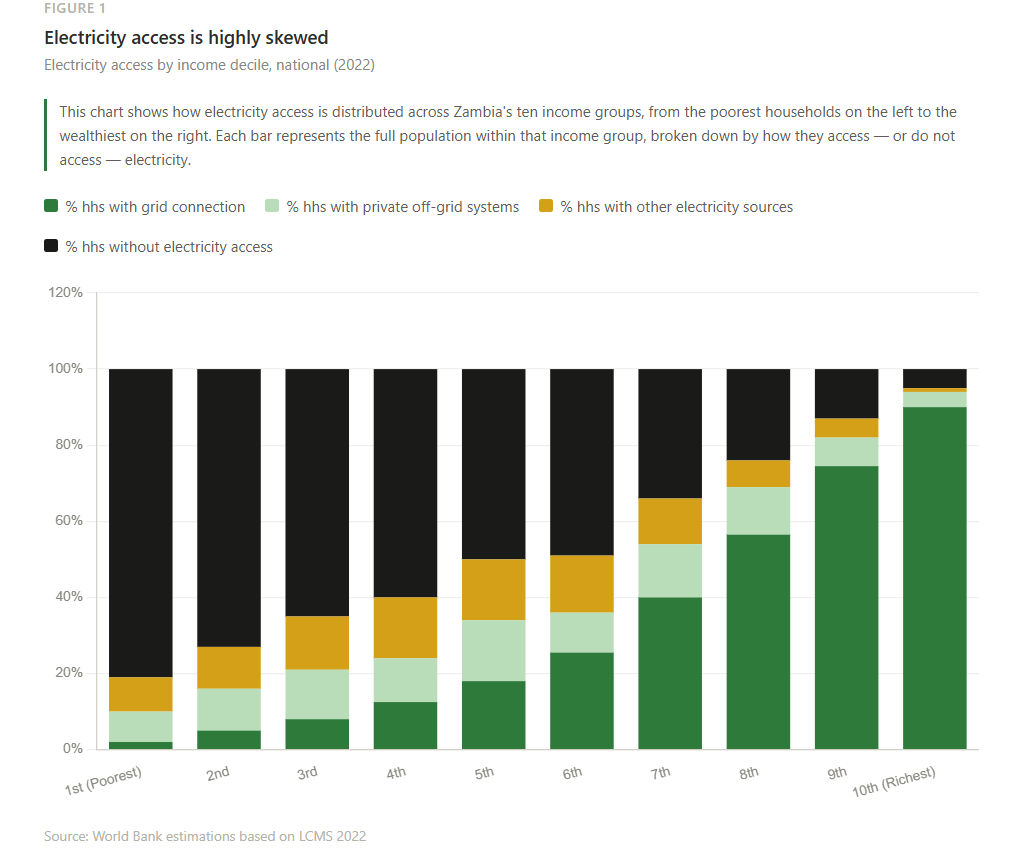
Urban access sits at 90%. In stark contrast, fewer than one in five rural households is connected to the grid with approximately ten million Zambians remain entirely without electricity. The more troubling inequity runs deeper than the absence of a connection. It lives in what happens to public money in the meantime.
Zambia's electricity subsidies are, by design, regressive. Because access itself is skewed toward wealthier households, the benefits of subsidised tariffs flow disproportionately to those who need them least. The top two income deciles capture 73% of total subsidy benefits, according to the country's energy sector assessment. Structured, however unintentionally, to serve the affluent, the system demands far more fundamental change than tinkering at the margins.
The Reform Trap
Zambia, like many sub-Saharan economies, faces mounting pressure to move toward cost-reflective electricity tariffs. Utilities operating below cost-recovery levels cannot sustain investment, maintain infrastructure, or expand access. The World Bank reports that moving to cost-reflective pricing without protective mechanisms is estimated to increase the national poverty rate by 0.68 percentage points, with urban households, more heavily electrified and therefore more exposed to tariff increases, bearing the sharpest impact.
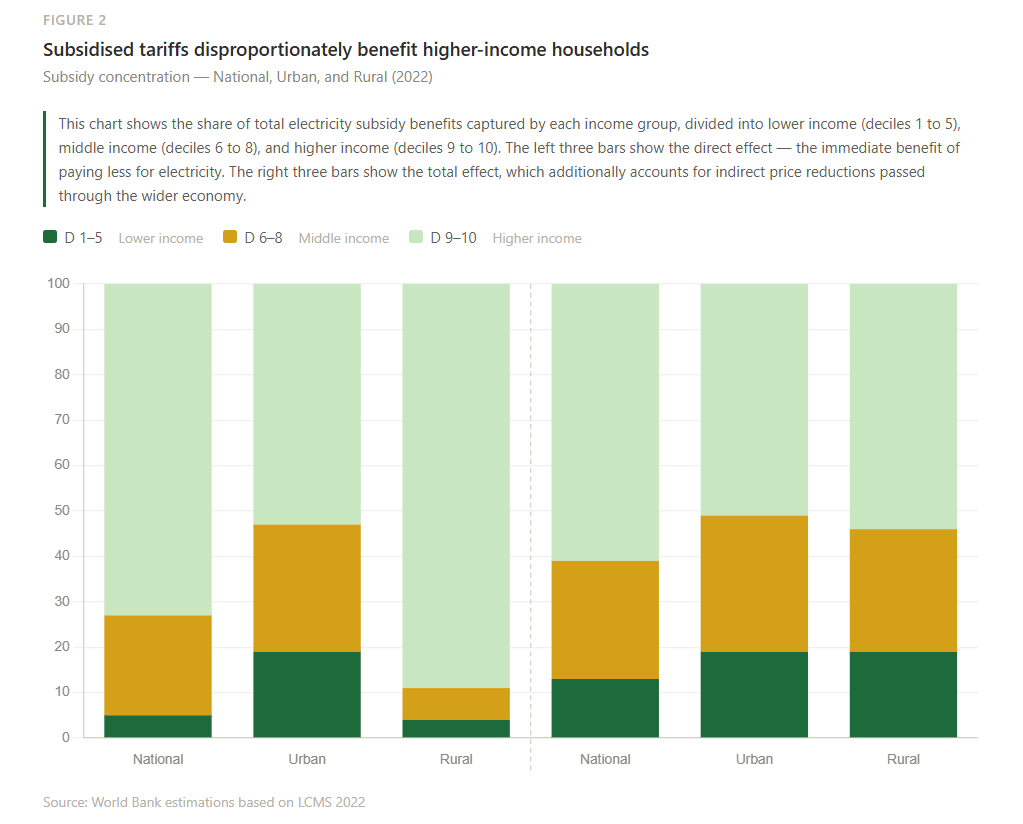
Tariff reform is not inherently wrong. Sequence and protection, however, matter enormously. Zambia's current tariff structure applies a uniform subsidised rate to all connected households regardless of income, with no mechanism to direct relief toward the poorest, a design that channels most benefits to wealthier households simply because they are the ones connected to the grid. Replacing this broad, poorly targeted approach with two more precise instruments offers a credible path forward. Lifeline tariffs would shield basic consumption for low-income households, and temporary cash transfers would be directed at the poorest 10% of the population. Neither tool is novel, and both have been deployed with measurable success in other markets. The challenge in Zambia, as elsewhere, remains political will and implementation capacity.
A longer-term structural risk is also embedded in the reform agenda. Policies such as net metering and open access are, in principle, sound instruments for accelerating the energy transition. These policies allow consumers with rooftop solar installations to sell surplus power back to the grid. Without carefully designed fixed network charges, they create a perverse incentive. Wealthier households, with the capital to invest in solar, migrate partially or fully off the grid, leaving the fixed costs of maintaining the network costs that do not shrink when customers leave, covering transmission lines, substations, and infrastructure upkeep to be recovered from a smaller, poorer base of remaining customers, effectively raising the per-household cost burden on those least able to absorb it. A policy designed to accelerate clean energy ends up transferring financial burden from the affluent to the vulnerable.
Rethinking the Grid
Beyond the subsidy question lies the rural electrification puzzle and here, the data challenges an inherited assumption. The World Bank estimates that for the ten million Zambians currently unserved, 72% can be reached more economically through off-grid solutions, mini-grids and solar home systems, than through conventional grid extension. Infrastructure economics have shifted decisively. The assumption that the grid will eventually reach everyone, given sufficient investment and time, is no longer a credible framework for universal access planning.
Even where connections exist, the relationship between electrification and poverty reduction is far from automatic. In remote rural areas with weak market connectivity, the welfare gains from a new electricity connection are limited. A household that can power a light or charge a telephone gains something real, without access to markets, productive enterprise, or reliable income, the full potential of electricity remains largely unrealised. A connection, in this context, is necessary but insufficient on its own.
The Dimension the Grid Cannot Solve
Aggregate access statistics tend to obscure a great deal. A headline figure of 51% national access sounds like a story of progress half-told. What it does not convey is the quality, reliability, or economic utility of that access, nor the distributional reality beneath it.
Clean cooking compounds the picture further. The 2022 Living Conditions Monitoring Survey (LCMS) by Zambia Statistics Agency (ZamStats), projected that over 90% of Zambian households still rely on traditional fuels (wood, charcoal, and agricultural residue) for their daily cooking needs. Health consequences fall most heavily on women and children, who bear the greatest exposure to indoor air pollution. Electricity access, even where it exists, has produced no meaningful shift away from solid fuels. Energy poverty, in this respect, carries a dimension that no grid extension programme can address on its own.
Ultimately, the central question of energy equity is distributional rather than technical: who pays, who benefits, and who is protected. Zambia's electricity sector sits at a crossroads that many developing economies will recognise genuine progress on access, real pressure on fiscal sustainability, and a credible risk that the reform path chosen entrenches the very inequalities it claims to address.
Electrification is a precondition for development. On its own, it falls well short of that destination. The difference separates a policy that counts connections from one that measures lives changed, and in the space between those two measures, ten million Zambians are still waiting in the dark.