
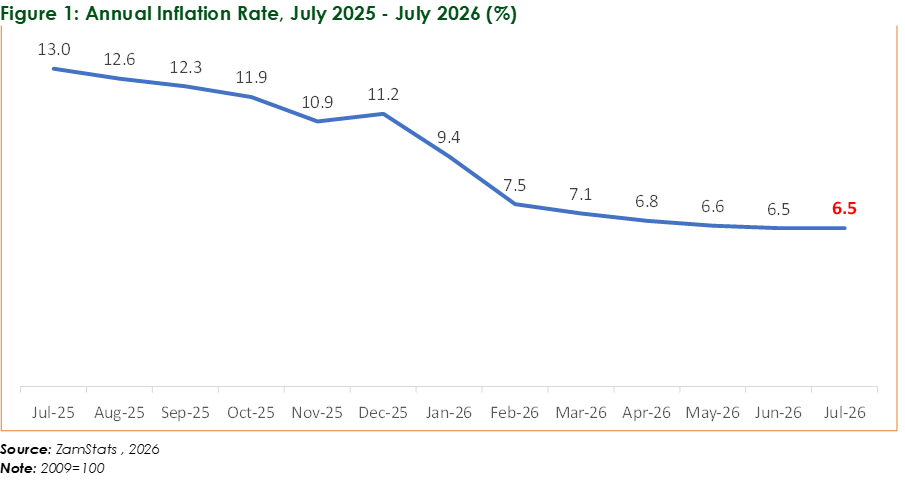
Samuel Sikazwe, Garden, Lusaka | 5 August 2026—The Zambia Statistics Agency compresses more than 23,000 retail prices into a single metric to shape the country's official economic baseline. Annual inflation held at 6.5% in July 2026, locking in the commercial stability recorded in June.
One Institution, One Legal Mandate, One Number the Country Runs On
Established under Statistics Act No. 13 of 2018, the Zambia Statistics Agency is the sole entity permitted to publish official statistics for the Republic. Prior to this legislative consolidation, disparate datasets from various government ministries sometimes created conflicting economic narratives. The 2018 Act centralised this authority to provide foreign investors, domestic corporations, and international financial institutions with a single, verifiable source of truth. Every figure that shapes national policy, from inflation to trade performance, passes through this institution first. The Agency collects its 23,000 monthly price quotations between the first and tenth day of each month. This narrow window leaves little room for delay once the count begins, requiring a highly synchronised networks of field enumerators operating across all 116 districts to capture real-time retail pricing on 440 distinct basket items.
Ms. Sheila S. Mudenda, Statistician General of the Zambia Statistics Agency, opened the July bulletin by presenting the data as an evolving economic snapshot.
"What do the Figures Say?" she asked.
The figures themselves confirmed that annual inflation held at 6.5% in July, unchanged from June. General prices for goods and services rose by that same margin between July 2025 and July 2026. Monthly inflation edged up to 0.2% in July from 0.1% in June. The Agency's monthly cycle is designed to catch these granular variations before they compound, offering corporate treasurers the data required to forecast their short-term purchasing power. Tracking these localised price fluctuations provides the Bank of Zambia with the unvarnished data required to calibrate its monetary policy decisions for the upcoming quarter.
A Mandate That Reaches Well Beyond a Single Bulletin
The Agency's work extends far past the inflation figure that tends to dominate headlines. Alongside July's price collection, ZamStats is currently conducting the 2026 Gender Equality Perception Survey to gather data on how Zambians across the country experience equality in their daily lives. Data collection for the second quarter Labour Force Survey is also underway, tracking employment trends that dictate future minimum wage reviews and national tax policy adjustments. Analysis and report writing for the 2025 and 2026 Crop Forecasting Survey is progressing in parallel. This specific dataset serves as the foundation for national food security planning, dictating whether the government authorises regional maize exports or issues import quotas to cover domestic agricultural shortfalls.
Four statistical exercises running simultaneously operate under the authority of one agency. Ms. Mudenda described the reasoning behind this concentration of responsibility strictly in terms of consistency.
"In undertaking its mandate as the sole designated entity responsible for the publication of official statistics, the Agency produces a number of statistical products in the Economic, Social, Agricultural and Environmental theme areas," she stated.
This concentration ensures that inflation figures shaping wage negotiations align methodologically with the crop forecasts driving agricultural imports. A single agency producing all national datasets means the underlying methodology stays consistent across every theme area the country depends on. Investors assessing sovereign bonds rely on this methodological continuity to price risk over a ten-year horizon. Commercial supply chains rely on this coherence equally. When transport companies factor the cost of fuel into their haulage contracts, they depend on ZamStats to provide an objective inflation measure that all contracting parties trust.
How a Bulletin Becomes a Tool for the Public
The Agency's stated purpose goes beyond simply publishing numbers and moving on to the next collection cycle. Ms. Mudenda has been direct about the practical applications the bulletin is designed to serve across the private and public sectors.
"The information shared may be used for various purposes including policy formulation, planning, implementation, monitoring and evaluation of development programmes, as well as research," she noted.
A commercial lender assessing loan risk, a retail owner setting inventory prices for the months ahead, and a government department drafting its next budget all lean on the same 6.5% baseline. Corporate landlords frequently tie annual rent escalations directly to the Consumer Price Index. When ZamStats confirms a 6.5% inflation rate, it immediately triggers contractual adjustments across millions of Kwacha in commercial real estate agreements. That number took shape from more than 23,000 individual price checks collected in physical markets and retail outlets. To ensure this data remains accessible beyond specialist economic circles, the bulletin includes a comprehensive glossary of terms. The Agency defines the Consumer Price Index as a measure of time-based changes in the general price level of household consumption goods. Inflation itself is defined as a sustained increase in the general level of prices over time. Providing these plain definitions attaches concrete commercial meaning to numbers that otherwise risk feeling abstract to the households they describe.
A Bulletin That Invites Scrutiny
Data collection at this national scale requires continuous operational refinement. Ms. Mudenda framed the bulletin as an active, two-way exchange of economic intelligence, inviting direct engagement from the commercial actors and policymakers who consume the data.
"I would like to urge our readers and users of statistical information to send to us any comments that may enhance statistical production and contribute to the improvement of this bulletin," she added.
That openness carries weight given how much capital rests on the figures the Agency produces each month. A 6.5% inflation rate is the outcome of a legally mandated, methodically repeated exercise that leaves the country with one trusted answer to a macroeconomic question every household, business, and policymaker asks at the same time. This month, for the second consecutive tracking period, that baseline remained static, securing a firm foundation for corporate planning across the Zambian market.