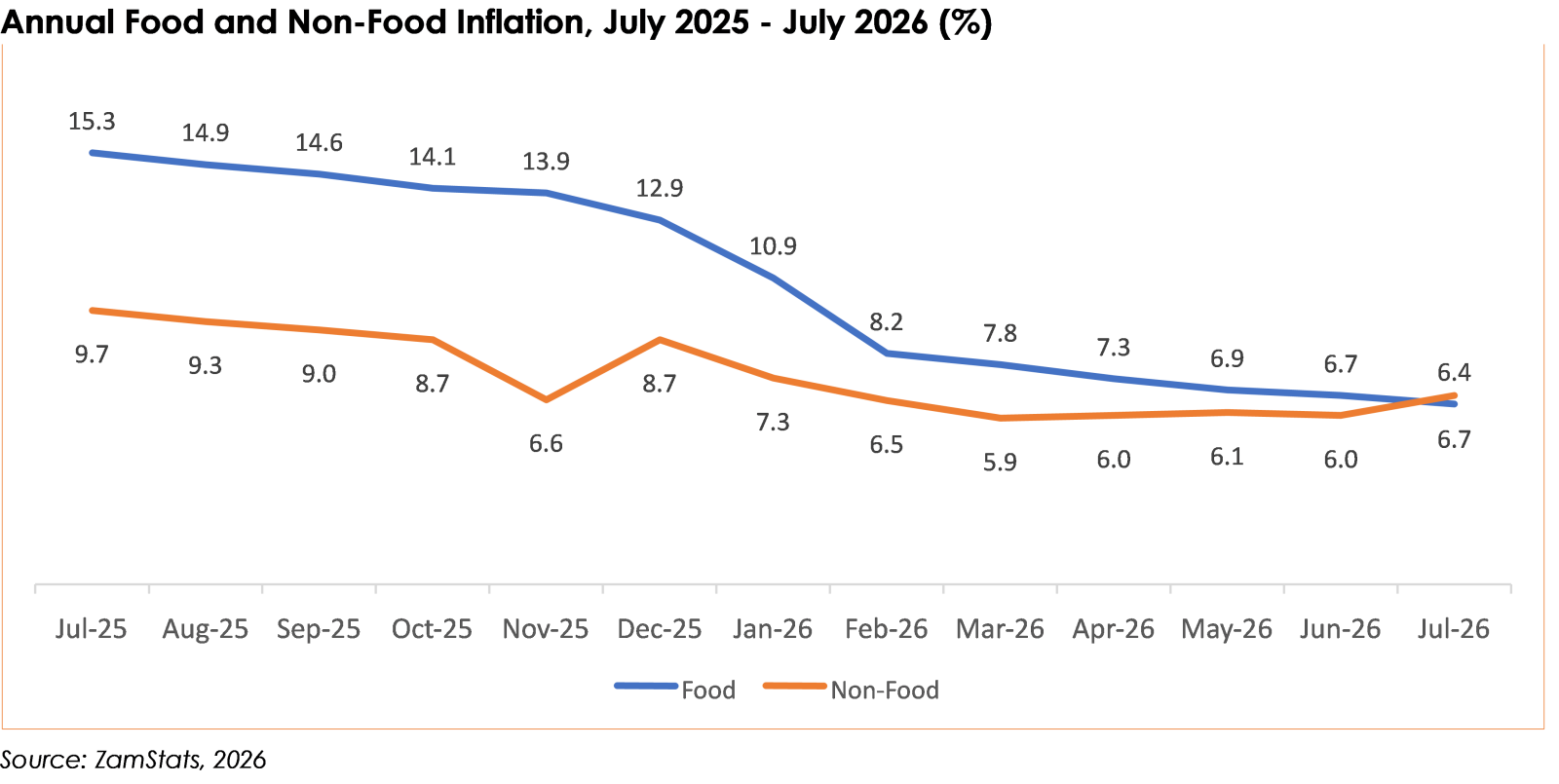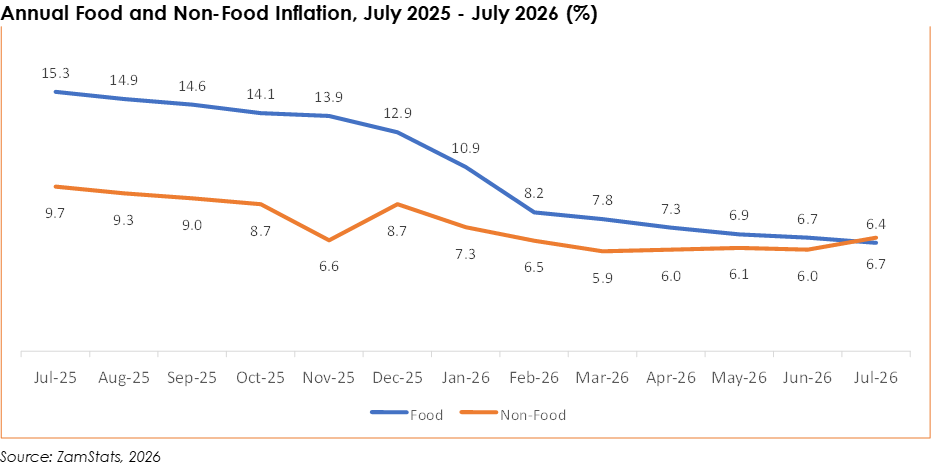
Samuel Sikazwe, Garden, Lusaka | 5 August 2026—Zambia's annual food inflation slowed to 6.4% in July 2026, registering its lowest rate since April 2018 according to the Zambia Statistics Agency. This deceleration in price growth directly eases the compounding pressure on household purchasing power.
National Stability Masks a Shifting Consumer Basket
National annual inflation held steady at 6.5% in July, unchanged from June. General prices for goods and services across the country rose by that same 6.5% between July 2025 and July 2026. The Zambia Statistics Agency's July 2026 Monthly Bulletin established the national baseline.
Food inflation eased to 6.4% in July, down from 6.7% in June. Non-food inflation moved the opposite way, climbing to 6.7% from 6.0%. On a monthly basis, food inflation halved to 0.1% from 0.2% recorded in June. Non-food prices told a different story, surging to 0.3% in July after a rare monthly deflation of minus 0.2% in June. Two halves of the same household budget are moving in opposite directions, continuously reshaping domestic purchasing power. This internal rebalancing requires corporate strategists to look beyond the 6.5% aggregate figure to understand actual consumer behaviour.
Transport and Utilities Erode Disposable Income
The figures confirm specific shifts in where commercial costs are rising fastest across the economy. Transport recorded the sharpest jump among the primary expenditure groups.
"Annual inflation for the transport sector," the bulletin detailed, "climbed to 5.7% in July from just 2.4% in June."
This swing proved large enough to shift the entire non-food category upward. Housing, water, electricity, and gas followed a gentler path upward, rising to 7.9% from 7.5%. Recreation and culture ticked higher too, moving to 6.7% from 6.6%. These increases directly consume the disposable income households might otherwise direct toward retail goods.
Elsewhere, the picture leaned toward relief. The health group recorded a slowdown to 8.9% from 9.6% in June. Alcoholic beverages and tobacco eased marginally to 7.8% from 7.9%. Clothing and footwear slowed to 6.6% from 7.0%. Restaurant and hotel costs cooled to 8.4% from 8.7%. Education held perfectly static at 4.3%, remaining the only primary group to show zero movement between the two tracking months. This mix of rising fixed utility costs and easing retail prices forces consumers to reallocate their monthly spending.
Contradictions Within the Grocery Aisle
Household staples moved broadly in the consumer's favour during July, reinforcing the data on easing food inflation. The national average price of breakfast mealie meal fell by 7.53% on the month, settling at K252.13. Roller mealie meal dropped by 8.96% to K202.28.
"Maize grain declined by 9.90% monthly and 12.32% annually," the Agency's data confirmed, "recording one of the steepest annual falls across any commodity in the bulletin."
Protein prices moved less predictably. Buka Buka fish recorded annual inflation of 22.14%, ranking among the sharpest increases in the entire dataset. T-bone steak rose by 17.00% over the same period. Dried Kapenta from Mpulungu barely moved at all, up just 0.11% annually to offer a rare pocket of stability. Lemons climbed by 20.26% annually. Tomatoes fell by 9.46% over the same period. These two produce items are moving in almost perfectly opposite directions within the same basket. A household's real inflation rate depends entirely on its specific dietary habits, with carbohydrate costs dropping as premium protein sources grow more expensive. When the price of staple grains falls, lower-income households immediately experience a functional increase in their disposable income. They can redirect these savings toward other essential services, offsetting the impact of rising utility bills.
Fuel Divergence Reshapes Logistics and Commuting
Fuel prices carried their own contradictions, affecting different segments of the economy in distinct ways. Diesel rose by 21.53% between July 2025 and July 2026. Petrol fell by 6.61% over the same period. This creates an unusual divergence between two fuels that typically move together. The surge in diesel prices directly impacts commercial logistics and public transport networks, as minibuses and heavy-duty freight trucks rely overwhelmingly on this fuel. Commercial distributors must factor this diesel inflation into their pricing models to protect their operating margins. The resulting overhead increases often cascade into the final retail price of delivered goods.
Conversely, the drop in petrol provides immediate financial relief to private vehicle owners. This split creates a dual-track pricing environment where public transit commuters face rising operational costs, and personal vehicle drivers experience a slight reduction in their monthly transport budgets. Toyota Hilux prices, tracked as part of the bulletin's vehicle basket, fell sharply too, down 23.08% annually. This drop in durable goods pricing offers a unique commercial opportunity for fleet operators looking to upgrade their assets in a high-diesel-cost environment.
The True Measure of Economic Resilience
Tracking more than 23,000 price quotations every month allows the Zambia Statistics Agency to isolate the precise points where household purchasing power expands or contracts. The deceleration of food inflation this month offers tangible relief to domestic consumers. The dropping cost of staple carbohydrates provides a firm buffer against the rising costs associated with housing and diesel.
Corporate planners rely on these granular distinctions to forecast retail demand. A uniform approach to pricing cannot address a bifurcated market where transport costs surge and basic food items grow cheaper. Companies must adapt to these specific supply chain and consumer realities.
Whether this overall stability holds through August remains the central metric the next bulletin will define. Isolating these specific local realities provides corporate supply chains and individual households with the predictable intelligence they require to manage their positions within the national economy. This granular tracking secures a resilient foundation for future commercial planning.